REVIEW · BUENOS AIRES
English Classes with Native Teachers
Book on Viator →Operated by Vamos Academy School · Bookable on Viator
Native English in Buenos Aires, in one focused hour. This short class at Vamos Academy is interesting because it’s taught in English only, with lessons built around your level and what you actually want to use English for.
I especially like the way you can plan the session with your teacher—conversation, vocabulary, grammar, or exam prep all fall into the same one-hour format. The teachers you might meet (names that show up often include Maria, Camila, Frederick, Ty, Taine, Linda, and Cortland) are a big part of why the classes feel both friendly and useful.
One thing to keep in mind: because it’s just about 60 minutes, you’ll get the best results if you show up with clear goals for the week, not vague hopes like better English someday.
In This Review
- Key things you should notice before you book
- Buenos Aires Meeting Point: Where Your Class Starts
- English-Only Lessons and Level Placement (A1 to C2 goals)
- How You Tailor a Class: Conversation, Grammar, Vocab, and More
- Native Teachers and the Accent Factor (Maria, Camila, Frederick, Ty, Taine, Linda, Cortland)
- What a One-Hour Session Actually Does for Your English
- Price and Value: Is $20 for 60 Minutes a Good Deal?
- Best for You If: Who Should Book This
- A Few Practical Considerations Before You Go
- Should You Book This English Class at Vamos Academy?
- FAQ
- How long is the English class?
- What levels are offered?
- Is the class taught in English?
- Is this a private experience?
- Where do I meet for the class?
- What happens if I cancel?
Key things you should notice before you book
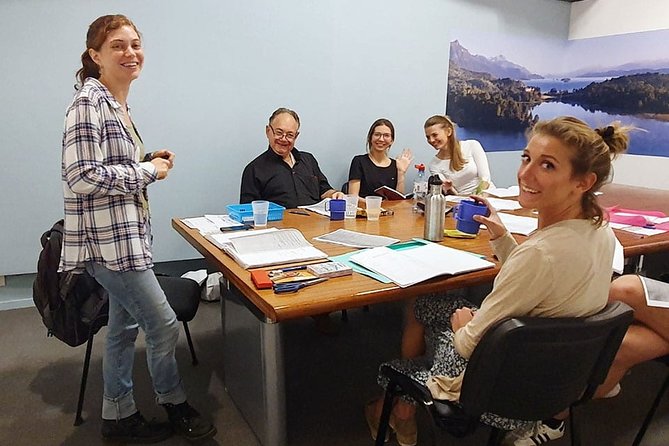
- English-only instruction: you’re pushed to use the language, not translate your way through it
- Six level tracks: A1 through C1, plus C2-style higher goals for special preparation
- Teacher-led tailoring: you can focus on conversation, grammar, vocab, or exam prep
- Native teaching experience: multiple native teachers means you can get used to different accents
- Private group setup: your group participates, not a random crowd
Buenos Aires Meeting Point: Where Your Class Starts
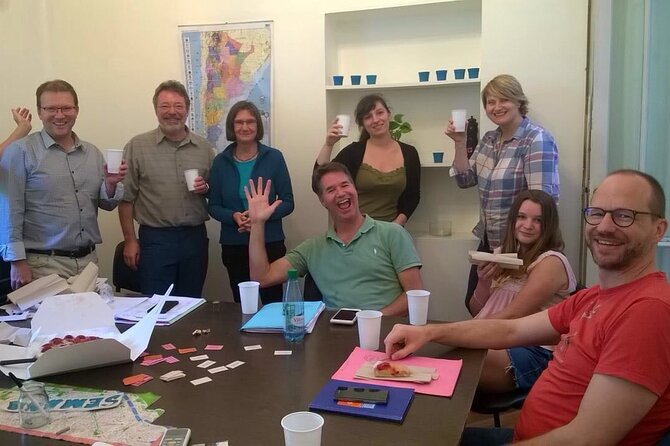
Your session begins at Vamos Academy Spanish School and English Classes, at Viamonte 1516 in Buenos Aires (C1055ABD). It’s in a central spot near public transportation, which matters because English class runs on time—no one wants to burn your only hour wrestling with transit.
The class ends back at the same meeting point, so you don’t have to plan a tricky second leg. Treat this as a quick anchor in your day: one stop, one productive hour, then you can go back out and use English with less pressure than a full-day language program.
If you’re thinking about timing, the academy lists hours from 9:00 AM to 9:00 PM, Monday through Friday. That flexibility is useful when your Buenos Aires days get full—museum mornings, neighborhood wandering, then a focused language session later.
You can also read our reviews of more tours and experiences in Buenos Aires



English-Only Lessons and Level Placement (A1 to C2 goals)
Here’s the core structure: Vamos Academy runs English courses across six levels—Beginner (A1), Elementary (A2), Pre-Intermediate (B1), Intermediate (B1+), Upper-Intermediate (B2), and Advanced (C1). They also mention a Higher (C2) category, which often means more specialized needs like exam preparation or plans to move to an English-speaking country.
What I like about this setup is that the levels aren’t treated like a strict “test score” ladder. Instead, levels are organized around communicative ability—what you can do in real situations and where you still need support. That’s a smart approach for short sessions. You’re not just studying grammar for the sake of it; you’re working on being able to function better in conversations.
Also, because the classes are entirely held in English, your teacher can respond in the language you’re trying to build. This is where level placement matters most: if you’re placed too high, you’ll spend the hour decoding. Too low, and you’ll feel stuck. The good news is that the academy offers options across the whole range, including more specialized exam prep arrangements if you need them.
How You Tailor a Class: Conversation, Grammar, Vocab, and More
The single best reason this experience can work for a lot of travel schedules is that you can tailor the lesson. The course description makes it clear you can steer the class toward what you care about—conversation, vocabulary, grammar, and even customized exam preparation.
In practice, that means you’re not paying for a generic lesson script. You’re paying for a teacher to help you make progress on a specific skill.
A simple way to get value fast:
- Tell your teacher what you want to do in the next week using English (small talk, asking directions, job-style conversations, presenting an idea).
- Pick one “sticking point” (for many learners it’s verb tenses, asking questions, or sounding natural when speaking).
- Leave the hour with a tiny plan for what to try outside class.
That kind of focus is the difference between an English class that feels busy and one that actually changes how you speak.
The academy also notes that academic staff can give tips so you get the most out of your study time. For short one-hour lessons, those tips matter. You want feedback on what to practice next, not just corrections inside the classroom.
Native Teachers and the Accent Factor (Maria, Camila, Frederick, Ty, Taine, Linda, Cortland)
Native teachers are a big selling point here, and the names that come up repeatedly—Maria, Camila, Frederick, Ty, Taine, Linda, and Cortland—suggest you may have variety. That’s not just trivia. Different native teachers often bring different teaching styles and different accents, and that can help you stop treating one accent as the “real” one.
One of the joys of learning abroad is that you naturally encounter new speech patterns. Having lessons with native speakers helps you train your ear to catch meaning quickly—especially when you’re speaking in a real setting later in Buenos Aires.
There’s also an emotional side to this that’s easy to overlook. A few of the strongest comments about the academy focus on how welcoming and helpful the staff and teachers are. When you feel comfortable, you’ll speak more. And if you’re learning English by doing, comfort is a tool.
If you’ve ever stopped yourself mid-sentence because you were worried about sounding wrong, this kind of teacher environment is exactly what you want.
What a One-Hour Session Actually Does for Your English
This experience is about one hour. That short format can be a blessing. You can show up, work, and leave without dragging a heavy course load behind you.
So what should that hour be doing?
Ideally, it’s structured around communication:
- You talk (a lot more than you do in book-only study)
- The teacher identifies the patterns that slow you down
- You practice the same idea again with better phrasing
Because the courses are organized around communicative competencies, the lesson should feel less like “English class” and more like “English use,” with grammar and vocabulary brought in as tools.
Also, you can keep taking these one-hour classes until you feel you’ve improved. That matters because English learning isn’t linear. Some weeks your speaking jumps. Other weeks you suddenly realize a grammar detail you never owned before. A repeated weekly rhythm lets those moments stack up.
A practical note: with only 60 minutes, the best learners show up ready. Bring:
- a small set of questions
- a short topic list (what you’re doing in Buenos Aires, what you’re learning, what you want to say)
- one target phrase or structure you want to use






Price and Value: Is $20 for 60 Minutes a Good Deal?
At $20 per person for about an hour, this is positioned like a serious-value option—especially if you’re using the session correctly.
Here’s the value math I’d use:
- If you leave each class able to speak more clearly about something specific, the hourly rate becomes easy to justify.
- If you treat the class like random practice without a goal, you’ll still enjoy it, but you may not feel the progress.
The structure here supports progress: native teachers, multiple levels, teacher planning for your needs, and the option for exam prep if that’s your mission. Those are features that usually cost more in many language programs.
And there’s another value factor: because you can study until you improve, you’re not forced into one rigid course length to get results. You can take the class as a tool while you’re traveling—then continue if it still helps.
If you’re comparing this to longer multi-week programs, the short format is ideal for travel periods. If you’re comparing it to cheaper group-only learning, the native-teacher aspect may be the deciding factor.
Best for You If: Who Should Book This
This class fits best if you:
- want native-speaker feedback without committing to a long course
- need a flexible schedule (the academy lists Monday through Friday hours spanning the day)
- prefer learning that’s guided by your goals, not a fixed textbook pace
- want practice in conversation and real communicative skills
It’s also a strong fit if you’re preparing for something specific. The program notes that exam preparation can be arranged, and higher levels (C2) often take individual classes or in private groups for targeted goals.
One more thing: the academy is called Vamos Academy Spanish School and English Classes. Some students study both languages there (English and Spanish). If you’re already planning Spanish lessons in Buenos Aires, being in the same institution for English can make your overall schedule simpler.
A Few Practical Considerations Before You Go
A couple of realities to set expectations:
First, English-only instruction is great for progress, but it can feel intense at the start—especially at lower levels. If you’re nervous, that’s normal. The best approach is to keep showing up and let the teacher steer you.
Second, you’ll get more from the session if you communicate your needs clearly. When you ask for what you want—conversation practice, grammar help, vocab for daily life—the class becomes more personal and less generic.
Third, because it’s a short one-hour lesson, it’s not a miracle cure. Think of it as focused training, not a full replacement for daily practice. If you can pair it with short English moments during your day (reading signs, speaking with shop staff, writing a few sentences), you’ll likely feel the improvement faster.
Should You Book This English Class at Vamos Academy?
If you want a practical way to improve English in Buenos Aires, this is an easy recommendation to consider—especially at its price. The combination of native teachers, English-only teaching, and level options from A1 to C1/C2 goals means it can fit beginners through advanced learners.
Book it if:
- you want a clear, teacher-guided focus on speaking and communication
- you like the idea of tailoring the lesson
- you’re in town for weeks (or months) and want a sustainable rhythm
Skip it (or wait) if:
- you expect the hour to fix everything without outside practice
- you’re looking for a one-size-fits-all class with no personalization
FAQ
How long is the English class?
The class lasts about 1 hour.
What levels are offered?
You can choose among six levels: Beginner (A1), Elementary (A2), Pre-Intermediate (B1), Intermediate (B1+), Upper-Intermediate (B2), and Advanced (C1). There’s also a Higher (C2) category, which may use individual classes or private groups.
Is the class taught in English?
Yes. The lessons are entirely held in English.
Is this a private experience?
Yes. It’s listed as a private tour/activity, so only your group participates.
Where do I meet for the class?
You meet at Vamos Academy Spanish School and English Classes, Viamonte 1516, C1055ABD Cdad. Autónoma de Buenos Aires, Argentina. The activity ends back at the same meeting point.
What happens if I cancel?
This experience is non-refundable and cannot be changed for any reason.